

If you need a used Dodge Charger HEMI engine, start by identifying your Charger’s exact engine, model year, drivetrain, and VIN before comparing replacement engines. The Charger has been offered with different HEMI configurations, including 5.7L and 6.4L V8 applications, and these engines are not automatically interchangeable simply because they belong to the same HEMI family. Engine generation, electronics, accessories, oil-pan configuration, transmission, and drivetrain can all affect fitment.
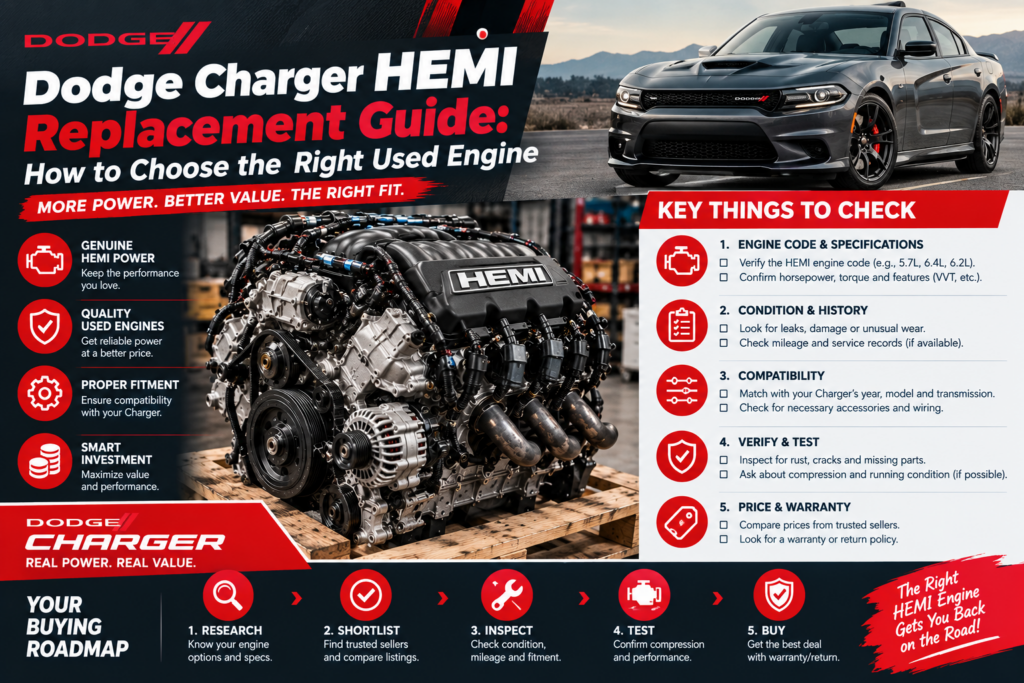
A used HEMI can be a practical solution when a Charger engine needs replacement, but the best buying process is based on exact compatibility and documented condition, not simply the lowest advertised price.
Whether you’re replacing a failed R/T engine, restoring a Charger, or planning a drivetrain project, this guide explains what to verify before buying a used Dodge Charger HEMI engine.
Quick Answer: What Should You Check First?
Before buying a used Charger HEMI, verify these details:
| Check | Why It Matters |
| Model year | HEMI configurations changed over time |
| VIN | Helps establish the vehicle’s original engine application |
| Engine size | 5.7L and 6.4L are different configurations |
| Engine generation | Earlier and later HEMIs can use different technology |
| Donor vehicle | Helps establish original application and history |
| Mileage | Useful when evaluating wear and value |
| Testing | Provides additional information about condition |
| Drivetrain | RWD and AWD configurations can affect compatibility |
| Included parts | Determines what you still need to source |
| Warranty/returns | Important protection for a used engine purchase |
The most important principle is simple: match the replacement engine to the vehicle, not just the HEMI name.
Which HEMI Engines Are Found in the Dodge Charger?
The Dodge Charger has used several engine configurations across different generations and trims.
The 5.7L HEMI V8 is associated with R/T applications, while the 6.4L HEMI has been used in higher-performance Charger variants. These are different engines and should not be treated as identical replacement units.
For example, the 5.7L HEMI and 6.4L HEMI differ in displacement and internal specifications. Factory documentation identifies the 5.7L as a 345-cubic-inch Gen III HEMI and the 6.4L as a 392-cubic-inch version.
This is why the first question should be:
“Which engine was originally installed in my Charger?”
not:
“Which HEMI engine can I find?”
5.7L vs. 6.4L: Don’t Assume They Are Direct Replacements
One of the most common questions is whether a 5.7L HEMI can simply be replaced with a 6.4L or vice versa.
Physically installing a different HEMI configuration can be possible in some projects, but that does not make it a straightforward factory replacement. Electronics, intake systems, tuning, accessories, sensors, and other components may need to be addressed.
For a standard engine replacement, matching the original engine configuration is usually the simpler starting point.
For a performance swap, the project should be planned as a complete system.
Why Engine Generation Matters
The 5.7L HEMI changed during its production life. Later versions introduced technologies such as variable valve timing, meaning an earlier 5.7L and a later 5.7L should not automatically be assumed to be identical replacement engines.
When searching for a used Dodge Charger 5.7 HEMI engine, confirm the specific year and engine configuration instead of relying on “5.7 HEMI” alone.
Use Your VIN Before Ordering
Your VIN is one of the most useful pieces of information when looking for a replacement engine.
It can help establish the vehicle’s original configuration and gives the seller or parts specialist a starting point for fitment verification.
Have these details ready:
- VIN
- Model year
- Charger trim
- Original engine size
- Transmission
- RWD or AWD configuration
- Intended replacement application
The drivetrain matters because Charger configurations have differed, and RWD and AWD vehicles can use different drivetrain components.
Why Trim Name Isn’t Enough
A trim such as R/T or SRT provides useful context, but it should not be the only information used to identify an engine.
Two Chargers from different years can have different engine-management systems or supporting components even when the trim names appear similar.
For a used engine purchase, the safest process is to verify the VIN, engine configuration, and donor application together.
What Is a Donor Engine?
A donor engine is a used engine removed from another vehicle for reuse.
The donor vehicle provides valuable information about the engine’s history.
Ask:
- What year was the donor Charger?
- What trim was it?
- Which engine did it have?
- What was its mileage?
- Was it running before removal?
- Why was the vehicle dismantled?
- Was the engine repaired previously?
- What components remain attached?
A donor vehicle that was dismantled because of collision damage may provide a different history from one removed because of an engine-related problem.
Donor information does not guarantee condition, but it helps you evaluate the engine more intelligently.
How Important Is Mileage on a Used HEMI?
Mileage matters, but it should never be the only factor.
A better assessment considers:
Mileage + maintenance history + donor history + testing + physical condition
For example, an engine with documented mileage and useful testing information provides more context than a listing that gives only a mileage number.
Ask whether the mileage is documented and whether the seller can provide information about the donor vehicle.
What Mechanical Tests Should You Ask About?
When purchasing a used engine, ask whether it has been inspected or tested.
Depending on the engine and seller, useful information may include:
- Compression testing
- Leak-down testing
- Oil-pressure information
- Running condition before removal
- Visual inspection
- Leak inspection
- Evidence of overheating
- Fluid condition
Testing cannot guarantee future performance, but it gives you additional information about the engine’s condition.
Inspect the Actual Engine
Whenever possible, request photographs of the actual engine being sold.
Look for:
- Broken connectors
- Damaged wiring
- Corrosion
- Cracked components
- Missing brackets
- Oil residue
- Coolant residue
- Impact damage
- Missing sensors
- Missing accessories
If something shown in a photograph is important to your installation, confirm that it is included rather than assuming it comes with the engine.
Complete Engine, Long Block, or Short Block?
Used HEMI engines may be sold in different configurations.
Understanding the terminology can help you compare listings accurately.
Complete Engine
A complete engine assembly may include external components and accessories, depending on the listing.
Always request an exact parts list.
Long Block
A long block generally includes the major assembled engine components, including the block and cylinder heads, while many external components are excluded.
Short Block
A short block typically represents the lower engine assembly and may require cylinder heads and other components before installation.
For a replacement project, determine which configuration you actually need before comparing prices.
What Parts Should You Confirm Are Included?
The engine itself may not be the only component you need.
Ask whether the package includes:
- Intake manifold
- Throttle body
- Fuel injectors
- Exhaust manifolds
- Alternator
- Starter
- Wiring harness
- Sensors
- Accessory brackets
- Oil pan
- Harmonic balancer
- Flexplate or flywheel
- Engine mounts
Factory engine assemblies can be sold with very different equipment depending on the application, so never assume that “complete” means every accessory is included.
Charger HEMI Fitment: What Else Should You Check?
Engine fitment involves more than physical dimensions.
Electronics
Modern Charger engines rely on electronic engine-management systems. Wiring, sensors, engine controllers, and other electronics may need to match the vehicle and engine configuration.
Intake and Accessories
The intake manifold and accessory drive can vary between applications.
A truck HEMI, for example, should not automatically be treated as a direct Charger replacement simply because both engines share a basic HEMI family. Differences in oil pans, accessories, and intake arrangements can require component changes.
Transmission
Confirm the engine’s relationship with your Charger’s transmission before ordering.
Consider:
- Transmission type
- Bellhousing arrangement
- Flexplate
- Starter
- Electronics
- Mounting
- Driveshaft
- Drivetrain configuration
RWD vs. AWD
This is particularly important for Charger buyers.
If your vehicle has AWD, verify drivetrain-specific fitment instead of assuming a RWD engine package will include everything necessary for the AWD configuration.
What Does a Used HEMI Replacement Really Cost?
The engine’s advertised price is only one part of the project.
A more realistic calculation is:
Engine + shipping + required components + preparation + installation = estimated replacement cost
You may also need to budget for:
- Fluids
- Filters
- Seals
- Gaskets
- Belts
- Hoses
- Sensors
- Wiring
- Cooling-system work
- Exhaust modifications
- Labor
For an engine swap, the supporting modifications can be substantially different from a direct replacement.
What Should You Do Before Installing the Engine?
Once you’ve purchased a used Charger HEMI, inspect it before installation.
Depending on the engine’s history and condition, a technician may recommend checking accessible maintenance items such as:
- Seals
- Gaskets
- Fluids
- Filters
- Spark plugs
- Belts
- Hoses
- Sensors
The appropriate preparation depends on the individual engine.
Find the Cause of the Original Engine Failure
If the Charger needs a replacement because the original engine failed, investigate the original cause.
For example:
Overheating: Check the cooling system.
Oil-related failure: Inspect the lubrication system.
Electrical failure: Check wiring and engine controls.
Fuel problem: Inspect fuel delivery.
Installing another engine without correcting an underlying vehicle problem can create another failure.
Questions to Ask Before Buying
Before purchasing a used Dodge Charger HEMI engine, ask:
- What vehicle did the engine come from?
- What year was the donor vehicle?
- What was the donor mileage?
- Which HEMI configuration is it?
- Was it running before removal?
- Has the engine been tested?
- What test information is available?
- What components are included?
- Has the engine been rebuilt or repaired?
- Does the engine match my VIN and application?
- Is it from a RWD or AWD vehicle?
- What warranty or return terms apply?
These questions can help identify compatibility problems before the engine is purchased.
People Also Ask About Used Dodge Charger HEMI Engines
What HEMI engines are available in the Dodge Charger?
The Charger has been offered with different HEMI V8 configurations, including 5.7L and 6.4L applications. Exact engine availability depends on model year and trim.
Can I put a 6.4 HEMI in a 5.7 Charger?
A 6.4 HEMI can be part of a swap project, but it should not be treated as a simple replacement. Electronics, intake, tuning, accessories, and other supporting components may need to be addressed.
Are all 5.7 HEMI engines interchangeable?
No. Different generations and applications can use different engine-management and supporting components. Verify the exact engine and vehicle before purchasing.
How do I identify the correct Charger HEMI?
Start with the VIN, model year, original engine size, transmission, and drivetrain. Then compare those details with the donor engine’s application.
Is a used HEMI engine worth considering?
A used engine can be a practical replacement option when its application, condition, history, and fitment are properly verified.
What should I inspect on a used HEMI?
Check donor history, mileage, testing information, visible condition, leaks, corrosion, wiring, connectors, accessories, and included components.
Can a Ram HEMI engine be used in a Charger?
Some HEMI engines share core architecture, but truck and car applications can differ in intake, oil pan, accessory drive, electronics, and other components. Compatibility should be verified for the specific engine and Charger.
Frequently Asked Questions
How do I find the correct used Dodge Charger HEMI engine?
Use your VIN, model year, original engine size, drivetrain, and transmission to establish the required application. Then compare those details with the donor engine.
Should I choose a 5.7L or 6.4L HEMI?
The correct choice depends on your Charger’s original configuration and project objectives. They are different engine configurations and should not be selected interchangeably without confirming the required supporting systems.
Does the donor vehicle matter?
Yes. The donor vehicle helps identify the engine’s original configuration, mileage, equipment, and service history.
What does a used HEMI long block include?
A long block generally includes the primary assembled engine components but does not necessarily include intake, exhaust, accessories, wiring, or other external components.
Can I reuse parts from my original Charger engine?
Some components may be reusable, depending on the specific engine generation and configuration. Confirm compatibility before transferring parts.
How important is mileage?
Mileage is useful but should be considered alongside engine testing, maintenance history, donor information, and physical condition.
Should I inspect a used HEMI before installation?
An inspection can help identify potential problems and determine whether maintenance items should be addressed before the engine is installed.
Used Dodge Charger HEMI Buying Checklist
Before ordering, confirm:
- VIN
- Model year
- Charger trim
- Original engine
- 5.7L or 6.4L configuration
- Engine generation
- Donor vehicle
- Donor mileage
- Testing information
- Actual engine photos
- Included components
- Wiring compatibility
- ECU/PCM requirements
- Transmission compatibility
- RWD/AWD configuration
- Cooling requirements
- Exhaust requirements
- Installation needs
- Warranty and return terms


Leave a Reply